
Navigate the Business Rates Increase 2026: Strategies for Startups
Prepare your startup for the business rates increase 2026 with essential strategies and insights.

Introduction
As business operations undergo transformation, the anticipated increase in business rates for 2026 presents a formidable challenge for startups. Startups face uncertainty as they prepare for the financial implications of the upcoming rates. Grasping how these new rates will impact operations is vital for stability and growth.
How can startups adapt their strategies to survive this financial shift and turn it into an opportunity for innovation and resilience?
Define Business Rates and Their Importance for Businesses
Business charges, known as non-domestic taxes, apply to various commercial properties such as offices, shops, and warehouses. These charges are calculated based on the property's rateable value, which reflects its estimated rental value. Understanding the implications of business charges is essential for new ventures, as these levies can significantly impact financial stability. Effective management of these costs can mean the difference between growth and financial strain.
Starting in April 2026, there will be a business rates increase 2026, with substantial modifications to commercial charges, including a new elevated tax percentage for properties with a rateable worth of £500,000 and above. Furthermore, small enterprises with an assessed worth below £12,000 will obtain 100% exemption from commercial charges, while those with amounts between £12,000 and £15,000 will gain from diminished assistance. The revaluation process occurs every three years to ensure that commercial charges align with current market conditions.
Recent statistics show that the total rateable value on England’s local list has risen by 19.4%, placing additional economic pressure on startups. Rising valuations are creating unexpected financial burdens for startups, complicating their planning. Consequently, many startups are finding it increasingly difficult to manage their financial obligations. The Small Business Rates Relief (SBRR) scheme, designed to alleviate this burden, is becoming less effective for many startups.
In this evolving landscape, Flux HQ's office space cost calculator can play a crucial role in enhancing budget control and cost clarity for startups. By estimating square footage early, the calculator enables companies to forecast rental costs more accurately, supporting smarter budgeting and assisting in avoiding commitments to spaces that exceed financial limits. Case studies highlight the challenges faced by startups, and tools like Flux HQ's calculator can provide the necessary insights to navigate these complexities.
Expert views highlight the significance of proactive management of financial charges for startups. As increasing costs become a significant challenge, it is essential for entrepreneurs to stay informed about changes and seek available relief options. By actively managing these financial charges, startups can not only survive but thrive in a competitive landscape.

Explore Key Changes to Business Rates in 2026
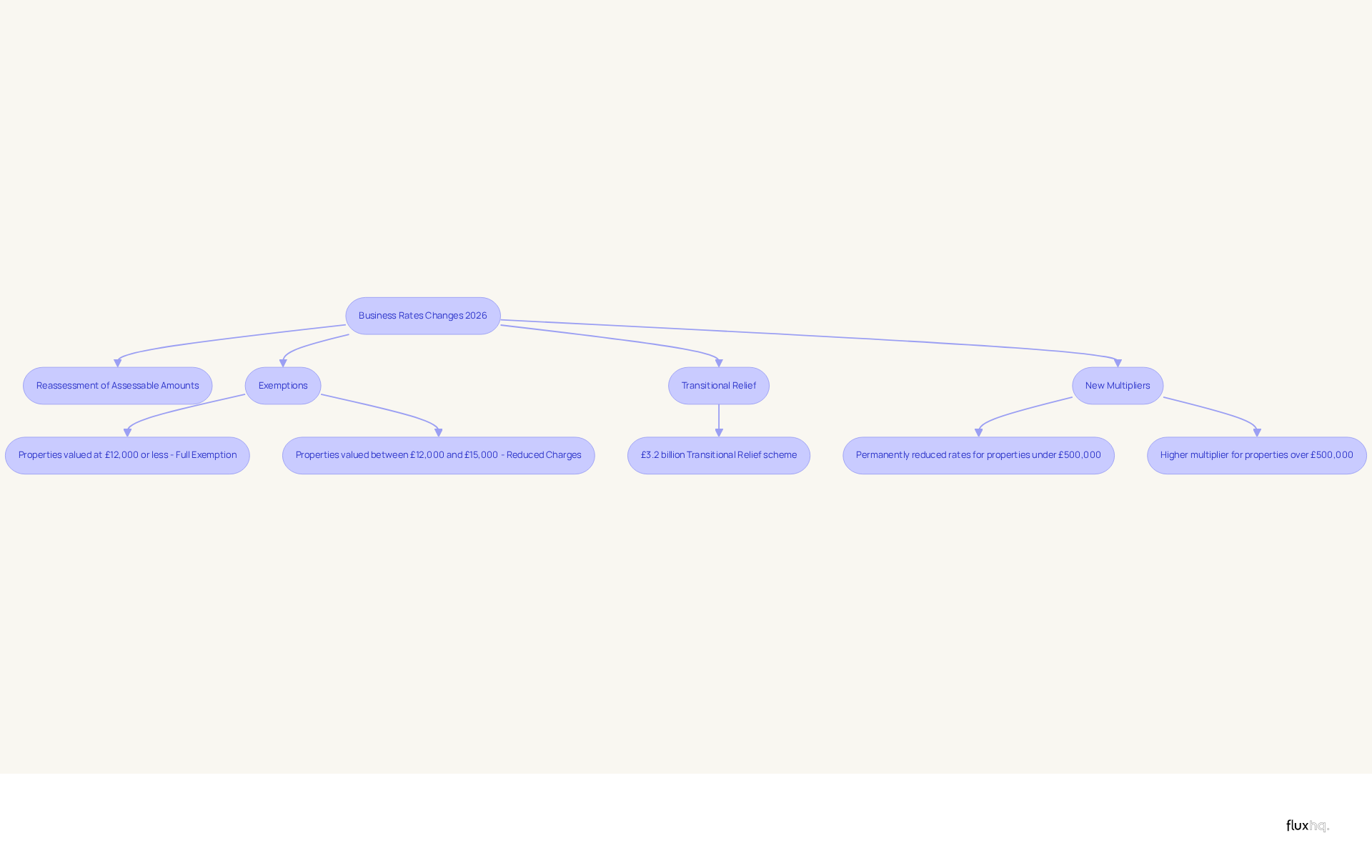
From April 1, 2026, businesses will face significant changes due to the business rates increase 2026 that could impact their financial strategies. A comprehensive reassessment of assessable amounts will be undertaken, introducing new multipliers. Properties valued at £12,000 or less will enjoy a full exemption, whereas those valued between £12,000 and £15,000 will see reduced charges. Additionally, the government plans to implement transitional relief measures to alleviate the financial burden on enterprises facing increased rates. This initiative forms part of a £4.3 billion support package designed to assist businesses during this transition, including a £3.2 billion Transitional Relief scheme for larger ratepayers like airports and hospitality venues.
The upcoming revaluation is expected to lead to significant increases in rateable values across various sectors, contributing to the anticipated business rates increase 2026, with many enterprises expecting higher bills. For instance, the Supporting Small Enterprise scheme will limit increases for those losing small enterprise relief to £800 or the applicable transitional relief percentage cap, whichever is greater. This initiative is crucial for startups and small enterprises that may be particularly vulnerable to sudden financial changes.
Furthermore, the introduction of permanently reduced rates multipliers for retail, hospitality, and leisure properties with a rateable value under £500,000 will provide additional relief, funded by a higher multiplier on properties valued over £500,000. This change is expected to benefit many enterprises in urban areas, including those in London’s vibrant districts like Soho and Shoreditch, where operational costs can be substantial.
Moreover, organisations should be aware of the new Duty to Notify system, which will require them to report changes in their property details to the Valuation Office Agency (VOA). Understanding these changes is essential for startups to navigate the evolving landscape and adjust their financial strategies accordingly. By proactively adapting to the impending changes, businesses can mitigate risks and seize new growth opportunities.
Implement Strategies to Mitigate Business Rates Impact
Startups often face significant challenges in managing business rates, but strategic approaches can alleviate these burdens:
- Review Rateable Values: Regularly assess and challenge your property's rateable value to ensure it accurately reflects current market conditions. Overpayments can significantly strain a startup's finances.
- Utilise Available Reliefs: Explore eligibility for various enterprise rates relief programmes, such as small enterprise rate relief or exemptions for charitable occupations. These programmes can greatly lessen economic pressures for eligible enterprises.
- Optimise Space Usage: Think about whether downsizing or optimising your office space could help reduce your rateable value. Flux HQ offers tailored office solutions, helping startups find spaces that suit their operational needs and reduce costs.
- Economic Forecasting: Incorporate enterprise charges into your monetary modelling to predict upcoming expenses. This foresight enables improved budget modifications and financial planning, ensuring that unforeseen price increases do not disrupt operations.
- Engage with Local Authorities: Stay informed about local council initiatives and relief programmes that may benefit your enterprise. Not engaging with local authorities may lead to missed opportunities for financial relief.
Ultimately, proactive engagement and strategic planning can transform the burden of business rates increase 2026 into an opportunity for growth.

Integrate Business Rates into Financial Planning and Modeling
Incorporating business rates into your financial planning is not merely advisable; it is essential for sustainable growth.
- Budgeting: Set aside a designated part of your budget to address expected charges, taking into account the business rates increase 2026. With the government support package of £4.3 billion aimed at easing transitions, it is essential to consider how these adjustments could specifically assist startups in managing their business rates.
- Scenario Planning: Use economic modelling tools to create different scenarios based on various assessable amounts and multipliers. Understanding the potential cash flow impact is vital for effective financial planning, especially as many sectors are expected to face significant business rates increase 2026 during the revaluation. Preparing for these increases will be essential for maintaining economic stability.
- Routine Evaluations: Perform regular assessments of your monetary strategies to adjust to any alterations in operational requirements or market conditions. Tools like Flux HQ's Office Space Calculator can assist in estimating costs and planning for future office requirements, allowing you to adapt to changing market conditions. This calculator enables you to estimate space for hybrid teams and includes common areas, providing a comprehensive overview of your workspace needs.
- Consultation: Collaborate with monetary advisors or specialists who focus on commercial charges to guarantee your strategies are effective and adhere to regulations. The introduction of the Duty to Notify system by the Valuation Office Agency (VOA) emphasises the significance of remaining aware of regulatory changes that could affect your enterprise.
By neglecting to manage business rates effectively, startups risk undermining their financial foundations and future prospects.

Conclusion
The impending increase in business rates in 2026 poses significant challenges for startups, necessitating strategic financial planning to ensure stability and growth. The upcoming changes, such as new exemptions and transitional relief measures, present both challenges and opportunities that startups must carefully consider and plan for. Startups may struggle to adapt to the evolving business rates, which could jeopardise their financial stability.
By employing strategies such as:
- Optimising space usage
- Engaging with local authorities
Startups can mitigate the financial impact of rising business rates. This proactive approach can lead to enhanced financial resilience and growth potential. Ultimately, by taking decisive action now, startups can not only weather the impending changes but also position themselves for future success in a competitive market.
Frequently Asked Questions
What are business rates and why are they important for businesses?
Business rates, also known as non-domestic taxes, apply to various commercial properties such as offices, shops, and warehouses. They are calculated based on the property's rateable value, which reflects its estimated rental value. Understanding these charges is crucial for new ventures as they can significantly impact financial stability.
What changes to business rates are expected in April 2026?
Starting in April 2026, there will be an increase in business rates, including a new elevated tax percentage for properties with a rateable value of £500,000 and above. Additionally, small enterprises with a rateable value below £12,000 will receive a 100% exemption from business rates, while those with values between £12,000 and £15,000 will benefit from reduced assistance.
How often does the revaluation process for business rates occur?
The revaluation process for business rates occurs every three years to ensure that the charges align with current market conditions.
What recent trends have been observed regarding rateable values in England?
Recent statistics indicate that the total rateable value on England’s local list has risen by 19.4%, which is placing additional economic pressure on startups and complicating their financial planning.
How is the Small Business Rates Relief (SBRR) scheme affecting startups?
The Small Business Rates Relief (SBRR) scheme, designed to alleviate the burden of business rates, is becoming less effective for many startups as rising valuations create unexpected financial challenges.
How can Flux HQ's office space cost calculator assist startups?
Flux HQ's office space cost calculator helps startups enhance budget control and cost clarity by estimating square footage early, allowing for more accurate forecasting of rental costs and supporting smarter budgeting.
What is the significance of proactive management of financial charges for startups?
Proactive management of financial charges is essential for startups as increasing costs pose significant challenges. Staying informed about changes and seeking available relief options can help entrepreneurs not only survive but thrive in a competitive landscape.
List of Sources
- Define Business Rates and Their Importance for Businesses
- Rising Business Rates: A Growing Challenge for Small Businesses | Spaceworks (https://spaceworks.org.uk/news/rising-business-rates-a-growing-challenge-for-small-businesses)
- Business rates revaluation 2026 (https://gov.uk/government/news/business-rates-revaluation-2026)
- Important changes to business rates in 2026 (https://bcpcouncil.gov.uk/business/business-rates/important-changes-to-business-rates-in-2026)
- Navigate Changes in Business Rates: Essential Strategies for Startups (https://flux-hq.com/articles/navigate-changes-in-business-rates-essential-strategies-for-startups)
- Changes to business rates from April 2026 (https://buckinghamshire.gov.uk/business/business-rates/changes-to-business-rates-from-april-2026)
- Explore Key Changes to Business Rates in 2026
- Rates of change business rates changes expected in 2026 (https://dwfgroup.com/en/news-and-insights/insights/2025/6/rates-of-change-business-rates-changes-expected-in-2026)
- Business rates revaluation 2026 (https://gov.uk/government/news/business-rates-revaluation-2026)
- 2026 Business Rates Revaluation (https://avisonyoung.co.uk/user-occupier/business-rates/revaluation)
- Business rates revaluation 2026 (https://enfield.gov.uk/services/business-and-licensing/business-rates-revaluation-2026)
- Changes to business rates from April 2026 (https://buckinghamshire.gov.uk/business/business-rates/changes-to-business-rates-from-april-2026)
- Implement Strategies to Mitigate Business Rates Impact
- More businesses set for tax relief as government unveils latest rates cuts (https://pinsentmasons.com/out-law/news/businesses-tax-relief-government-rates-cuts)
- Business rates relief (https://gov.uk/business-rates-relief)
- Important changes to business rates in 2026 (https://bcpcouncil.gov.uk/business/business-rates/important-changes-to-business-rates-in-2026)
- Pubs Get 15% Rates Cut; Other Firms Overlooked (https://startups.co.uk/news/pub-support-package)
- Finance Minister backs local businesses by extending rate support schemes (https://finance-ni.gov.uk/news/finance-minister-backs-local-businesses-extending-rate-support-schemes)
- Integrate Business Rates into Financial Planning and Modeling
- Business rates revaluation 2026 (https://gov.uk/government/news/business-rates-revaluation-2026)
- 2026 Business Rates Revaluation (https://avisonyoung.co.uk/user-occupier/business-rates/revaluation)
- Business rates changes from April 2026 (https://cambridge.gov.uk/business-rates-changes-from-april-2026)
- Changes to business rates from 1 April 2026 (https://redditchbc.gov.uk/business/tax-funding-finance/changes-to-business-rates-from-1-april-2026)
- Changes to business rates from April 2026 (https://buckinghamshire.gov.uk/business/business-rates/changes-to-business-rates-from-april-2026)
More Articles
Back to Industry Knowledge
Secure Office Space in St James's Park: A Step-by-Step Guide
Discover how to secure office space in St James's Park with our comprehensive step-by-step guide.

Secure Your Office Space in St Pancras: A Step-by-Step Guide
Discover essential steps to secure your ideal office space in St Pancras efficiently.

Master Office Space in Tower Hill: Key Practices for Startups
Discover essential strategies for securing office space in Tower Hill for startups.

