
Why Flexible Offices in London Are Essential for Startup Success
Discover why a flexible office in London is crucial for startup success and operational agility.

Introduction
London’s office spaces are undergoing a significant transformation, with flexible offices emerging as essential for startup success. Navigating a competitive market presents significant challenges for startups. The benefits of adaptable workspaces, including cost efficiency and improved collaboration, are becoming essential. However, this dilemma necessitates a careful evaluation of workspace options. Ultimately, this evaluation could determine the long-term viability of their business operations.
Understand the Shift: The Rise of Flexible Offices in London
In 2026, London's workspace environment has undergone a remarkable transformation, with a flexible office in London emerging as the preferred choice for startups. This shift arises from the growing need for agility in business operations, the rise of remote work, and the imperative for cost-effective solutions. The COVID-19 pandemic served as a catalyst, encouraging many companies to adopt adaptable work arrangements that allow for swift adjustments to changing circumstances.
Statistics indicate that the adaptable workspace market in London is projected to reach 50 million square feet by 2030, accounting for approximately 20% of the overall workspace market, up from around 12% today. This growth reflects a broader trend where businesses prioritize flexibility, with many opting for a flexible office in London that enables them to scale operations as needed.
Industry experts highlight the significance of this trend. They emphasise that the modern workplace is no longer merely about desks; it is a cultural hub that fosters collaboration and innovation. As Alan Pepper, CEO of Orega, notes, "Flex allows these businesses to remain agile while maintaining high-quality working environments."
Flux HQ is instrumental in this evolving landscape, simplifying the leasing process for businesses looking for a flexible office in London. Their expert guidance and access to premium and off-market London workspaces ensure that startups can find tailored solutions that align with their business goals and operational flexibility. From initial brief to rental negotiation and move-in, Flux HQ oversees every detail of the renting process, leveraging strong industry ties and long-standing landlord relationships to provide options that others simply cannot.
Numerous case studies illustrate the expansion of adaptable workspaces. For instance, a recent study highlighted how new businesses utilising adaptable spaces have effectively managed the challenges of hybrid work models, enabling them to enhance their operational efficiency without the burden of long-term leases. Furthermore, the demand for personalised work environments has surged, as companies recognise that a customised workspace can significantly improve productivity and employee satisfaction.
As the landscape continues to evolve, the ability to adapt will determine which businesses succeed in this competitive arena.

Explore the Benefits: Cost Efficiency and Adaptability for Startups
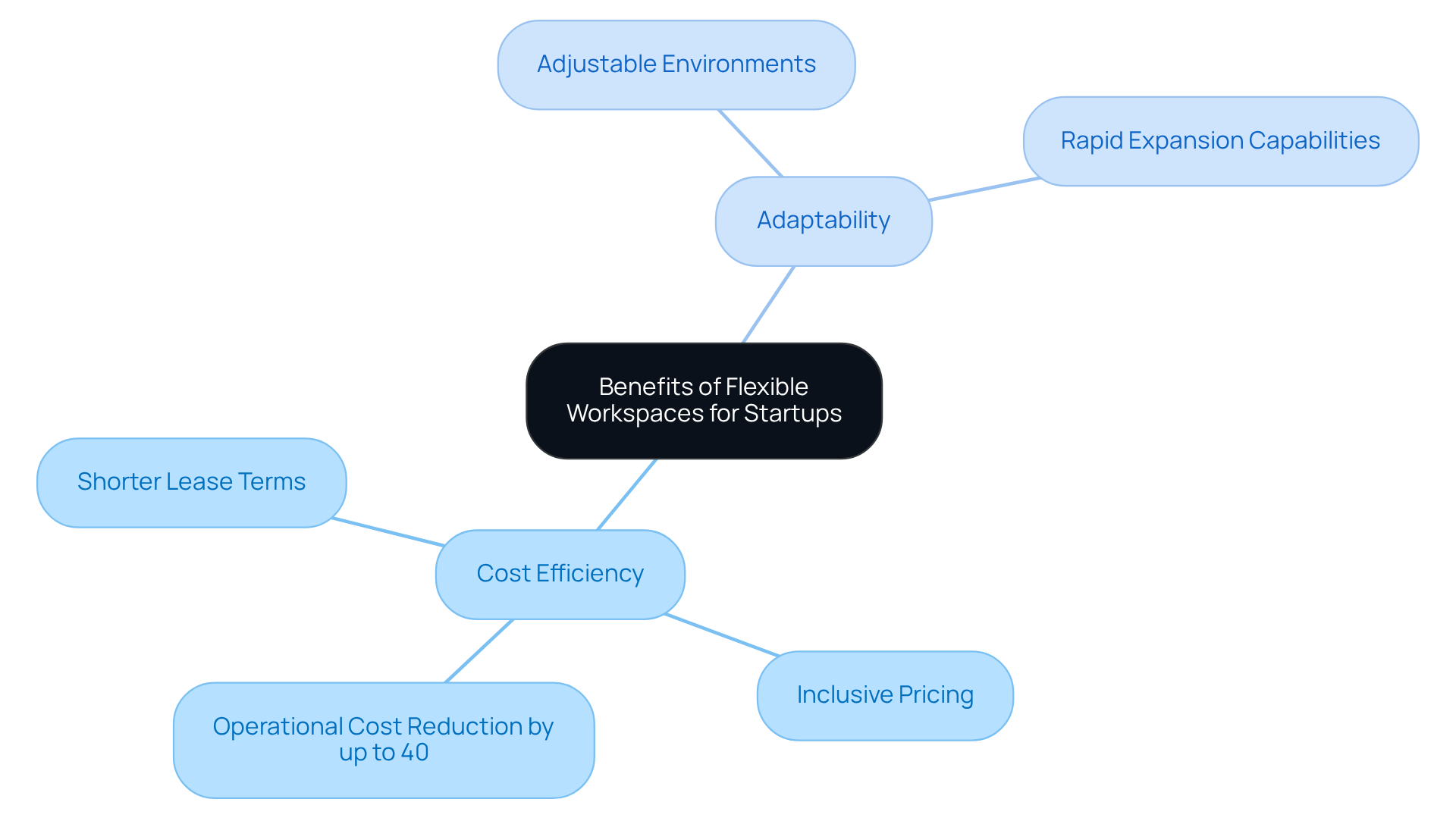
In the competitive landscape of London, new businesses face daunting financial challenges, yet flexible workspaces present a viable solution. Shorter lease terms and inclusive pricing allow new businesses to avoid the hefty upfront costs of long-term commitments. This financial flexibility is vital for businesses with tight budgets, enabling better resource allocation.
Moreover, adaptable workspaces enable businesses to adjust their environments as needs evolve. For example, a rapidly growing technology firm can quickly expand its workspace as it hires new talent, free from the constraints of a lengthy rental agreement. Such adaptability is essential in a fast-paced market where conditions shift rapidly.
Evidence shows that businesses opting for flexible workspace solutions can reduce operational costs by up to 40% compared to traditional leases. These savings can be reinvested in key areas like product development and marketing, boosting overall agility. The ability to adjust operations not only supports immediate goals but also fosters long-term viability, making flexible workspaces essential for new ventures navigating the uncertainties of expansion in 2026.
Analyze the Impact: Enhancing Startup Culture and Operational Agility
Adaptable work environments are not merely beneficial; they are essential for fostering a thriving entrepreneurial culture. Open layouts, communal areas, and shared resources in these environments encourage team members to interact and exchange ideas. For new ventures, where creativity and collaboration thrive, such an environment enhances productivity and fosters a sense of community. Research indicates that 71% of coworking members feel more creative in their spaces, highlighting the positive impact of these environments on innovation.
At Flux HQ, we provide fully managed, furnished, and ready-to-move-in serviced workspace leases that are perfect for rapidly growing businesses seeking short-term flexibility. The operational flexibility offered by adaptable workspaces enables new businesses to shift rapidly in reaction to market fluctuations. For instance, a startup may need to reconfigure its workspace to accommodate a new project team or adjust its layout for a hybrid work model. Flexible office in London solutions allow these adjustments without the logistical challenges linked to traditional office agreements, thereby supporting a dynamic and responsive business model. As businesses increasingly adopt hybrid working patterns, the ability to adapt workspace configurations becomes a strategic advantage.
Case studies demonstrate this trend: mid-sized companies are shifting from traditional leases to adaptable workspace solutions, driven by the need for operational efficiency and the desire to maintain versatility in their occupational footprint. This shift not only improves collaboration but also enables new ventures to flourish in a competitive environment, as they can adapt to changing demands without being limited by long-term obligations. As the demand for flexibility grows, businesses that embrace adaptable workspaces will find themselves better positioned for success in an ever-evolving landscape.

Evaluate the Trade-offs: Balancing Flexibility and Stability in Office Choices
While adaptable workspaces present numerous advantages, they also introduce significant challenges that new businesses must navigate. One significant drawback is the potential lack of long-term stability that conventional agreements provide. This instability can lead to operational disruptions and affect team morale. Additionally, adaptable workspaces often incur higher costs per square foot than traditional agreements, which can strain a startup's finances over time. For instance, a private serviced workspace for a ten-person team in London typically costs between £4,000 and £7,000 per month, all-inclusive. This expense may surpass the total occupancy costs linked to a conventional rental agreement when considering fit-out and operational costs, which frequently exceed the all-inclusive monthly charge of adaptable workspaces.
As adaptable workspaces, including flexible office in London, are expected to represent about 20% of the overall workspace market by 2030, increasing from roughly 12% currently, it is essential for new businesses to carefully evaluate their unique needs and growth trajectories when deciding between flexible and traditional workspace options. Conventional leases, although providing freedom in design and branding, usually necessitate a commitment of three to ten years, which may not correspond with the ever-changing nature of many new businesses. Furthermore, the operational management of serviced spaces is handled by the provider, enabling new businesses to concentrate on their primary activities without the weight of space management.
At Flux HQ, we understand the unique challenges faced by new businesses and strive to provide tailored workspace brokerage solutions. By utilising our market expertise and solid connections with property owners, we can assist new businesses in locating the appropriate flexible office in London options that align with their growth strategies. Our knowledge in negotiating flexible agreements with break clauses guarantees that companies can expand or reduce as necessary, offering the agility that many new ventures need. We also provide support with legal lease reviews and negotiations, advocating for the best terms to protect your business.
By weighing the benefits of flexibility-such as rolling monthly contracts and the ability to scale up or down-against the desire for stability, new businesses can make informed decisions that best support their operational strategies and long-term objectives. Furthermore, with a higher business rates multiplier set to apply to properties with a rateable value of £500,000 or more starting from April 2026, financial considerations will play a crucial role in this decision-making process. Ultimately, the workspace decision could either propel a startup towards success or impede its growth.

Conclusion
In the ever-evolving landscape of business, the role of flexible offices in London emerges as a pivotal factor for startups navigating the complexities of a dynamic environment. These flexible workspaces provide vital advantages that help new ventures succeed, such as cost savings, operational flexibility, and a collaborative culture. With the increasing need for adaptable solutions, startups that embrace these innovative options position themselves for success in an increasingly competitive landscape.
This article has shown how flexible office spaces allow startups to quickly adapt to their evolving business needs, enabling them to scale operations without the burden of long-term leases. The financial benefits, including reduced operational costs and more effective resource allocation, further underscore the significance of these workspaces. Moreover, the collaborative atmosphere fostered by flexible environments enhances creativity and productivity-essential elements for any startup aiming to innovate and grow.
Ultimately, startups face a crucial decision when choosing between flexible and traditional office spaces, one that can shape their future. By thoughtfully considering their specific operational needs and the trade-offs involved, new businesses can make informed choices that align with their long-term goals. As the landscape of work continues to evolve, opting for flexible spaces could be the key to unlocking a startup's full potential in a competitive market.
Frequently Asked Questions
What is driving the rise of flexible offices in London?
The rise of flexible offices in London is driven by the need for agility in business operations, the increase in remote work, and the demand for cost-effective solutions, particularly accelerated by the COVID-19 pandemic.
What is the projected growth of the adaptable workspace market in London by 2030?
The adaptable workspace market in London is projected to reach 50 million square feet by 2030, which will account for approximately 20% of the overall workspace market, up from around 12% today.
How do industry experts view the modern workplace?
Industry experts view the modern workplace as a cultural hub that fosters collaboration and innovation, rather than just a space with desks.
What role does Flux HQ play in the flexible office market?
Flux HQ simplifies the leasing process for businesses seeking flexible offices in London by providing expert guidance, access to premium and off-market workspaces, and overseeing every detail of the renting process.
How do adaptable workspaces benefit new businesses?
Adaptable workspaces allow new businesses to manage the challenges of hybrid work models effectively, enhancing operational efficiency without the burden of long-term leases.
What is the impact of personalized work environments on companies?
Companies recognize that personalized work environments can significantly improve productivity and employee satisfaction, leading to a surge in demand for customized workspaces.
What will determine the success of businesses in the evolving workspace landscape?
The ability to adapt will determine which businesses succeed in the competitive workspace landscape as it continues to evolve.
List of Sources
- Understand the Shift: The Rise of Flexible Offices in London
- Flex Comes of Age: What will 2026 bring for Flexible Workspace (https://orega.com/news/flexible-workspace-trends)
- How to Beat London’s Sky-High Office Rents in 2026 - Blog | BluDesks.com (https://bludesks.com/blog/2026/05/22/why-flexible-office-space-london-is-becoming-the-smarter-choice)
- UK Flexible Office Market Trends 2026 Insights | Workthere posted on the topic | LinkedIn (https://linkedin.com/posts/workthere_the-flexible-office-market-has-shown-remarkable-activity-7407025974866763776-39o6)
- 2026 UK Flexible Office Space Trends (https://rubberdesk.co.uk/research)
- The Latest Coworking Statistics & Industry Trends [2026] (https://archieapp.co/blog/coworking-statistics)
- Explore the Benefits: Cost Efficiency and Adaptability for Startups
- Budget-Friendly Short Term Office Solutions for Startups in London: 2025 Guide (https://canvasoffices.co.uk/news/budget-friendly-short-term-office-solutions-for-startups-in-london-2025-guide)
- A complete guide to flexible office spaces - BizSpace (https://bizspace.co.uk/insights/a-complete-guide-to-flexible-office-spaces)
- Flexible Office Space vs Traditional Office Leases in UK (https://cityflex.co.uk/article/flexible-office-vs-traditional-lease)
- Managed Office Space: Expert Guidance for Growing Businesses in 2026 (https://cbre.co.uk/property-search/office-space/coworking/guides/managed-office-space-expert-guidance-for-growing-businesses)
- Why savvy businesses are choosing flexible office spaces (https://savills.co.uk/blog/article/372520/us-articles/why-savvy-businesses-are-choosing-flexible-office-spaces.aspx)
- Analyze the Impact: Enhancing Startup Culture and Operational Agility
- 2026: The Year Flex Space Becomes a “Professionalized” Industry (https://linkedin.com/pulse/2026-year-flex-space-becomes-professionalized-ve6ne)
- Productivity Hack: Data Shows Flexible Coworking Spaces Are Revolutionizing the Modern Workplace. - Aura Innovation (https://aura-innovation.co.uk/coworking-spaces-productivity-hack)
- Flex Comes of Age: What will 2026 bring for Flexible Workspace (https://orega.com/news/flexible-workspace-trends)
- How Flexible Workspaces Are Supporting UK Business Growth in 2026 - Orbit Spaces (https://orbitspaces.co.uk/how-flexible-workspaces-are-supporting-uk-business-growth-in-2026)
- Why Flexible Office Space is the Secret to Scaling Your Startup (https://dcreport.org/2026/04/27/why-flexible-office-space-is-the-secret-to-scaling-your-startup)
- Evaluate the Trade-offs: Balancing Flexibility and Stability in Office Choices
- Flexible Office Space vs Traditional Office Leases in UK (https://cityflex.co.uk/article/flexible-office-vs-traditional-lease)
- Flex Comes of Age: What will 2026 bring for Flexible Workspace (https://orega.com/news/flexible-workspace-trends)
- Serviced Office vs Traditional Lease: Which Is Better for Start-ups? - Business Focus (https://businessfocusmagazine.com/2026/03/26/serviced-office-vs-traditional-lease-which-is-better-for-start-ups)
- Flexible Workspace for Startups in 2026 | Beginest (https://beginest.com/blog/flexible-workspace-for-startups-2026.html)
- Savills UK | Major trends for European flex offices in 2026 (https://savills.co.uk/insight-and-opinion/savills-news/385919/major-trends-for-european-flex-offices-in-2026)
More Articles
Back to Industry Knowledge
4 Best Practices for Choosing Office Space in Southwark
Discover essential best practices for selecting the ideal office space in Southwark.

Best Practices for Choosing Office Space in St James for Startups
Discover essential best practices for selecting office space in St James tailored for startups.

Why Office Space in Spitalfields is Ideal for Growing Startups
Discover why office space in Spitalfields is perfect for startups seeking growth and innovation.

