

Start with the operating decision
The right choice is not automatically the quickest move or the lowest apparent monthly figure. It is the option whose private capacity, shared facilities, flexibility and total commercial arrangement continue to work as your business changes.
Flexible office space can adapt through adjustable leases, layouts and shared amenities, and may include private, managed, serviced or coworking space. A serviced office is typically furnished and ready to use, with some arrangements including internet, utilities, cleaning, maintenance and reception. The specific operator’s inclusions still need checking.
Use four questions to make the first decision:
- Do you need a ready-to-use workplace? A furnished office with shared services may reduce the setup work associated with taking an empty conventional unit, although the move-in timetable depends on the operator and the space.
- Will attendance or headcount change? A serviced office may make upsizing or downsizing easier.
- Do shared facilities suit the way you work? Communal meeting rooms, kitchens and breakout areas can reduce the facilities you need inside your private suite, but you need to understand access, capacity and any additional charges.
- Can you accept less permanent customisation? Serviced offices may offer less scope for fixed branding, specialist layouts or changes to the fabric of the space.
A serviced office deserves a serious shortlist when those answers point towards flexibility and operational simplicity. A conventional lease may deserve more attention when you need a highly customised environment, a defined long-term footprint or greater control over the premises. Test those conditions before you compare individual properties.
What a serviced office includes and how it differs
A serviced office is a managed, furnished workspace prepared for use, with selected operational services arranged by the operator rather than by you. Typical inclusions may cover furniture, internet, utilities, cleaning, maintenance and reception, and some arrangements place those essentials within one monthly payment. Treat that description as a starting point: the agreement should identify each inclusion, exclusion and charge for the space you are considering.
The difference from a conventional leased office is therefore broader than furniture. It concerns who carries day-to-day responsibilities, how much of the building’s shared infrastructure you use, how the arrangement can change, and how the cost is presented.
Serviced office
You occupy a prepared private workspace and may use communal rooms and amenities. The arrangement can reduce the need to organise infrastructure and multiple suppliers, while a ready-to-use space may shorten the move-in process. The trade-off can be less permanent branding and a higher cost per square foot than conventional rental, because the price may include amenities and flexibility.
Managed office
Managed space is another flexible-office format within the wider category. Compare it on the actual division of responsibilities: identify what is fitted for you, what is managed for you, which facilities are shared and which services are separately charged. Do not assume that the label alone establishes the same inclusions as a serviced office.
Conventional leased office
A conventional leased unit usually gives you a different level of responsibility for fitting out, operating and managing the premises. One comparison describes traditional full repairing and insuring leases as five to ten years, while it describes flexible office contracts as six to 36 months. Those are descriptions from one comparison, not a rule for every UK property, so treat the actual term, break arrangements and obligations as property-specific questions.
Coworking and hot-desk access
Coworking space can suit a team that needs shared workspace rather than a dedicated suite. Hot-desk access can be relevant when attendance is highly variable and fixed desks are not required. For either route, check the access rules, privacy, meeting-room allocation, storage, visitor arrangements and capacity at the times your team needs to work.
Your first comparison should therefore record the office format, private-space arrangement, shared facilities, operational responsibilities, flexibility and total cost structure. That gives you a more useful basis for shortlisting than the phrase used in the listing.
Overview
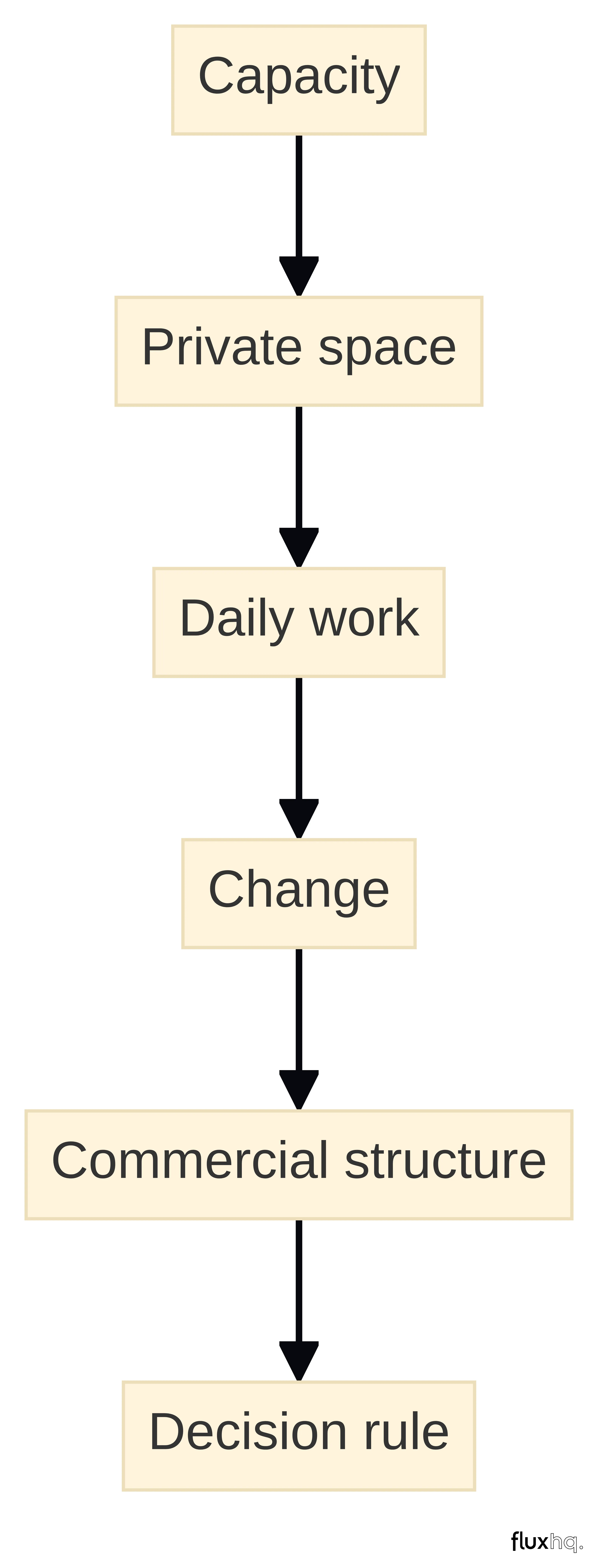
The serviced-office decision becomes clearer when you separate the requirement into capacity, working experience, change and commercial structure. Use the following filter before asking for options.
- Capacity: Record current headcount, expected hires and peak attendance rather than using total headcount as the only desk measure. A hybrid team may need fewer desks than employees, but the correct number depends on actual attendance patterns.
- Private space: Decide which people need dedicated desks, which work can happen at shared desks, and which conversations require enclosed rooms. Shared meeting rooms, kitchens and breakout areas may reduce the private suite size, provided access and capacity work for your team.
- Daily work: Specify the balance between open desks, private offices, phone space, meeting rooms, collaboration areas, reception and storage. The workplace needs to support the work you actually do, not an abstract desk count.
- Change: Set out likely hiring, contraction, relocation or attendance changes over the proposed term. A first serviced office can be assessed alongside future expansion, a move to managed space or a more bespoke workplace.
- Commercial structure: Compare the full arrangement rather than a headline monthly figure. Record what is included, what is charged separately, how business rates are treated, and which terms govern notice, renewal and changes.
A practical decision rule follows from this filter: pursue a serviced office when its capacity and facilities match your real working week and its flexibility fits the next change you can reasonably describe. Keep other formats in the comparison when your business needs permanent customisation, a different responsibility split or a longer, more defined occupation.
Do not ask for a property shortlist until you can describe those conditions. A broker can then search against a requirement instead of trying to infer your operating model from a team size alone.
Size the private space around real attendance
Private office size should start with the people who need to work there at the same time, then account for the rooms and facilities that the operator provides outside the suite. Current headcount is only the first input.
Build the attendance picture
Record these figures separately:
- total employees;
- people expected to join during the proposed term;
- typical attendance by day of the week;
- the busiest expected attendance day;
- people who need a fixed desk because of their role or equipment; and
- visitors, contractors or clients who may need meeting space without using a desk.
A cited guide gives 60 to 70 desks per 100 employees as one serviced-office working norm. That figure is planning guidance from one source, not a default ratio for your team. Use your peak attendance, role requirements and agreed access rules to test whether it is relevant. If Monday attendance is materially higher than Friday attendance, a ratio based on the weekly average may leave you short when the office is busiest.
Separate desks from shared facilities
A serviced office may provide meeting rooms, kitchens and breakout spaces communally outside your private suite. In that arrangement, you can size the private office primarily around desk needs, but only after checking how many people may use each facility, whether bookings are required, what access hours apply and whether extra usage is charged.
This distinction changes the brief. Instead of asking only for a certain number of square feet, describe the private desk capacity and the shared facilities your team must be able to use. A smaller suite is not a sensible saving if the meeting-room supply, breakout capacity or visitor arrangement does not match your working pattern.
Add a growth assumption carefully
One guide suggests a 10% buffer for terms under two years, 15% to 20% for two- to three-year terms, and 25% for three- to five-year commitments. Treat those figures as planning guidance rather than a rule. Your hiring plan, desk ratio, attendance pattern and ability to expand within the building should determine the buffer you request.
Write the assumption beside the number. For example: “12 current employees, 15 expected within 12 months, peak attendance of 11, and a preference for room to add three desks.” That statement is more useful than “small office for 15” because it shows how you reached the capacity requirement.
Test the number against the term
A short commitment may justify a smaller initial footprint if expansion within the building is credible and the additional cost is understood. A longer commitment may make unused capacity more expensive if the growth assumption does not materialise. Ask for the expansion route, timing, notice requirements and pricing treatment before you treat the buffer as a reason to take more space.
The immediate action is simple: calculate the private desk requirement from peak attendance, add only the growth capacity you can explain, and list communal facilities separately. Then send both figures in the brief.
Specify how the team will work inside it
The workplace requirement should describe how your team works, because desk capacity alone cannot show whether a serviced office will function on a busy day. Start with the activities that need privacy, concentration, collaboration, visitors or specialist equipment.
Use this working-pattern checklist:
- Open desks: State the number of seats needed and whether desks are assigned, shared or available through a booking system.
- Enclosed rooms: Identify private offices, phone booths and quiet rooms required for confidential calls or concentrated work.
- Meeting rooms: Give the number of rooms, approximate sizes, expected frequency and the largest group you need to host. A mix of small, medium and larger rooms may be more useful than one room that rarely matches the meeting size.
- Breakout areas: Explain whether informal discussion, project work or social interaction needs a dedicated area outside the desk zone.
- Reception and client areas: State whether visitors need a staffed arrival point, waiting area or a presentable client route.
- Kitchen and refreshment facilities: Record whether a shared kitchen is sufficient, whether meals are prepared on site, and whether access at your working hours matters.
- WCs and accessibility: Include the number, location, accessibility and privacy requirements that affect your choice. Ask how shared facilities are accessed and maintained.
- Storage and wall space: List archive storage, equipment cupboards, lockers, shelving, screens and whiteboards before these compete with desks and circulation.
- Technical space: Identify communications, server, secure equipment or cooling requirements where your work depends on them.
- Furniture: State whether standard furniture is suitable or whether you need adjustable seating, specialist desks or modular arrangements.
Open layouts can support collaboration but may create noise. Enclosed rooms can support privacy but reduce the area available for desks. Your brief should therefore state the balance you need rather than asking for an undefined “modern office”.
For shared facilities, ask about capacity at peak attendance, booking limits, charges, access hours and whether your team receives priority. A kitchen, meeting room or breakout area listed as an amenity is not enough to establish that it will work for your schedule.
Use a short scenario to test the requirement: describe your busiest expected day, the number of people on calls, the meetings you host, the visitors arriving and the equipment in use. If the arrangement cannot accommodate that scenario without relying on assumptions, keep it out of the shortlist until the gap is resolved.
Match flexibility to the next business change
Lease flexibility has value only when it matches a change your business may need to make. A shorter or more adjustable arrangement can help with uncertain headcount, but flexibility should be compared with cost, capacity and the conditions attached to change.
One comparison describes flexible office contracts as six to 36 months and traditional full repairing and insuring leases as five to ten years. Actual terms vary by property and agreement. Use those figures to understand the contrast between the examples, not to assume that every serviced office falls inside the same range.
Map the next likely change before choosing a term:
- Hiring: If you expect a defined number of hires, ask whether additional desks or a larger suite can be secured in the same building and what lead time applies.
- Downsizing: If attendance or headcount may fall, identify whether the arrangement permits a smaller suite, a different desk allocation or an early exit, and record the conditions.
- Working-pattern change: If hybrid attendance may increase or decrease, test the desk ratio, meeting-room demand and shared-space access rather than changing only the number of desks.
- Fundraising or budget pressure: Compare the financial commitment with the period over which you can justify the footprint. Do not treat a shorter term as automatically cheaper overall.
- Client or team-location change: If your clients, recruitment area or operating location may change, assess whether the office remains useful or whether a move would be more practical.
- Need for customisation: If brand expression, specialist equipment or a fixed layout will become more important, record the point at which a serviced office may no longer meet the requirement.
A serviced office can be assessed as a first stage while you keep future expansion, a move to managed space, a more bespoke workplace or a different building under review. That future route should be part of the brief. Ask what can change within the current building and what would require a new agreement.
Separate flexibility into three questions:
- Term: How long are you committing to the space?
- Change: What can change during that period, such as desks, suite size or access?
- Exit: What notice, break or end-of-term conditions apply?
Do not describe an arrangement as flexible until you have written answers to all three. A short term with no practical expansion route may not support growth, while a longer term with usable change provisions may fit better than a nominally shorter option.
Compare the commercial arrangement, not just the monthly figure
The commercial comparison should show what you pay, what the payment covers and what responsibility remains with you. A serviced office may cost more per square foot than conventional rental because the price can include amenities and flexibility. A conventional leased unit may present separate charges, including business rates in some arrangements, so comparing rent alone can produce a misleading result.
| Comparison point | Serviced office | Conventional leased office |
|---|---|---|
| Starting condition | Typically furnished and ready to use, subject to the specific space and operator | May require you to arrange more of the fit-out, infrastructure and operational setup |
| Payment structure | Some arrangements bundle furniture, internet, utilities, cleaning, maintenance and reception into one monthly payment | Rent, service charges, utilities and other premises costs may appear as separate responsibilities or bills |
| Flexibility | May make upsizing, downsizing or leaving easier, depending on the agreement | One comparison describes traditional full repairing and insuring commitments as five to ten years; actual terms vary |
| Private-suite planning | Communal meeting rooms, kitchens and breakout areas may sit outside the suite | You may need to plan and fund more facilities within the premises, depending on the unit and agreement |
| Customisation | Permanent branding and changes to the space may be more limited | You may have greater control, subject to the lease, building and fit-out conditions |
| Cost question | Compare the full fee, included services, usage limits and additional charges | Add rent to the separate costs and responsibilities that apply to the unit |
Use a like-for-like schedule rather than trying to remember the details from viewings. Record:
- the quoted fee and the period it covers;
- the term, notice, renewal and change provisions;
- furniture, internet, utilities, cleaning, maintenance and reception included in the fee;
- meeting-room, breakout, kitchen, storage and visitor access;
- charges for additional usage, dedicated facilities or changes;
- business-rates treatment and who receives or pays any relevant bill;
- deposits, payment timing and any price-review wording; and
- costs or responsibilities that remain with you after move-in.
For a conventional leased unit, business rates may be billed by the local council separately from rent and service charges. That does not establish how rates are treated in every serviced-office arrangement. Ask the operator to state the billing structure for the specific option.
A useful comparison has two totals: the recurring occupancy payment and the additional cost of the facilities and responsibilities needed for your working pattern. It should also show what happens if you add desks, use more meeting-room time, leave early or renew. Mark each unknown as an open question rather than filling it with an estimate.
The immediate action is to ask for the commercial terms in a comparable format. Do not shortlist an option solely because its advertised monthly figure is lower.
Key Highlights
The serviced-office decision rests on five practical tests:
- Capacity follows attendance. Start with peak concurrent attendance, fixed-desk needs and projected headcount. A guide’s desk ratio can inform the conversation, but it should not replace your own working pattern.
- Shared facilities change the space calculation. Meeting rooms, kitchens and breakout areas outside the suite may reduce the private footprint, provided capacity, access and charges work for you.
- Flexibility has a purpose. Link the term and change provisions to hiring, contraction, hybrid attendance, relocation or a future need for customisation.
- The monthly figure is only one line. Compare included services, usage limits, separate charges, business-rates treatment and the responsibilities that remain with you.
- The brief should describe work, not only desks. Include meeting-room sizes, breakout areas, kitchen, WCs, reception, storage, technical requirements, furniture and visitor needs.
A serviced office is a workable route when those five tests produce a clear fit. If one test remains uncertain, turn it into a question for the shortlist rather than treating the uncertainty as a reason to choose or reject the format.
Turn the decision into a broker-ready requirement
A broker-ready requirement gives enough structure to search for suitable options without pretending that a property, price or availability has already been confirmed. Prepare the following record before you make contact.
1. Business and location
State your business type, preferred UK locations, acceptable travel pattern, client-access needs and any areas that are unsuitable. If London is relevant, name the districts you would consider rather than writing only “central London”. Explain whether location is driven by staff travel, clients, recruitment or a particular operating relationship.
2. Team and attendance
Record current headcount, expected headcount at the start of the term, projected headcount during the term, typical attendance and peak attendance. Identify dedicated-desk requirements, shared-desk requirements and any people who need private offices because of role, equipment or confidentiality.
3. Private space and facilities
Give an approximate private-office size or desk range, then list the facilities that must work around it:
- number and size of meeting rooms;
- breakout or collaboration areas;
- kitchen or refreshment requirements;
- WCs and accessibility needs;
- reception and visitor arrangements;
- phone booths or quiet rooms;
- storage, lockers and wall space;
- technical or secure equipment space; and
- furniture requirements.
State which items must be inside the private suite and which can be shared. For shared rooms and amenities, include expected peak use and the access or booking conditions you need.
4. Working pattern
Describe a normal day and the busiest expected day. Include calls, confidential work, client meetings, team sessions, focused work, social use and any shift or extended-hours requirements. This gives the search a practical test rather than leaving the workspace to be judged from photographs.
5. Growth and flexibility
Give the desired start date as a planning requirement, desired term, expected hiring or contraction, preferred expansion route and any change or exit conditions that matter. If the business is uncertain, state the uncertainty directly and identify the decision that would resolve it.
6. Commercial boundary
Set out your budget as a planning range and state whether it should include the services you expect to use. Confirm the treatment and billing structure for business rates for any serviced office with the operator. Treat all returned figures as indicative until the specific property and agreement have been checked.
Flux HQ simplifies the office-space search by understanding your goals, budget, team size and growth plans. We align the search with your business goals, future headcount and operational flexibility. Send the record in this order so the search starts with the operating requirement rather than a generic request for an office.
Send the requirement for tailored options
A serviced office is suitable when the private capacity matches your real attendance, the shared facilities support the way your team works, the flexibility corresponds to your next likely change and the commercial arrangement remains clear after every included and additional cost is recorded. If those conditions are not clear, keep the requirement open and resolve the specific unknown rather than relying on a headline figure.
Flux HQ manages the office-leasing process from your initial brief through lease negotiation and move-in. A qualified professional should decide whether any particular arrangement is suitable for your circumstances, including its legal and financial implications. Use the completed requirement to request tailored options; any estimate remains indicative rather than a quote or confirmed booking.
What should you confirm before requesting serviced office options?
How can I determine the right size for a serviced office based on my team's needs?
To size a serviced office, consider your current headcount, expected hires, and peak attendance.
What factors should I consider when assessing the costs of a serviced office?
When evaluating costs, compare the total monthly fee, which may include furniture, utilities, and services, against separate charges for conventional leases. Ensure to clarify how business rates are treated and what additional costs may arise.
What information should I include in my office requirement when contacting a broker?
Your office requirement should detail your business type, current and projected headcount, desired office size, necessary facilities (like meeting rooms and kitchens), and any specific working patterns or flexibility needs.
What flexibility options should I look for in a serviced office lease?
Check the lease terms for flexibility regarding duration, the ability to adjust space as your needs change, and conditions for early termination or downsizing. Understanding these options can help align the office space with your business's future plans.
How do shared facilities in a serviced office impact my space requirements?
Shared facilities like meeting rooms and kitchens can reduce the need for larger private office space. When sizing your office, focus on the number of desks required and confirm access to these shared amenities.
What should I do if I have uncertainties about my office space needs?
If uncertainties exist, keep your office requirement open-ended and seek clarification on specific points before finalizing your search.


